Check this answer on the demo, 0:53. Recorded in the chat and Checks › Check results on Meridian Simulation, a simulated retailer. Nothing is mocked up. Recorded under the working name, Ontos. Captions are in the player.
What to look at
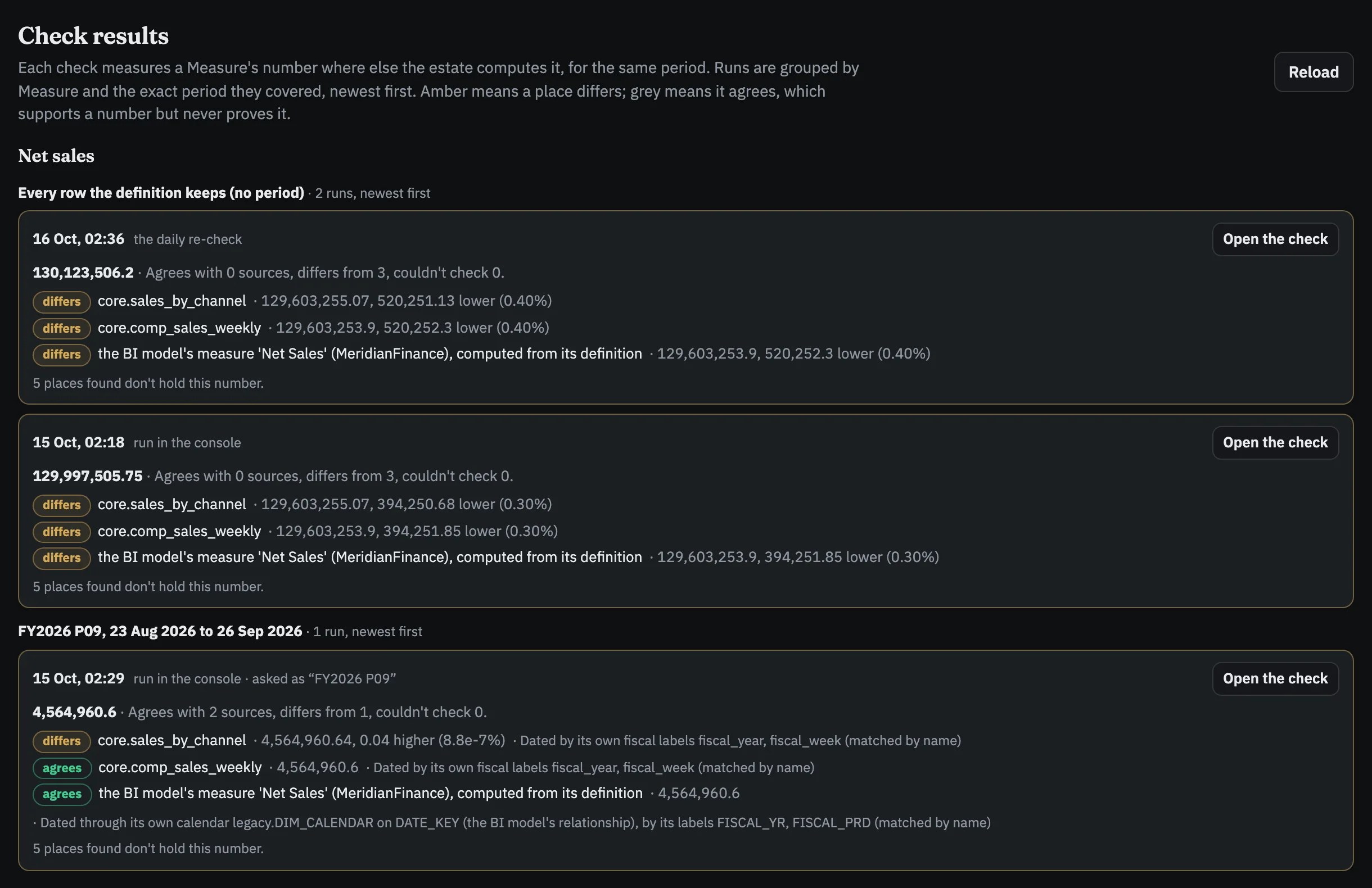
On our demo estate, net sales for fiscal period 9 is certified on the warehouse’s daily sales table: 4,564,960.60 SAR. A summary table loaded from it, core.sales_by_channel, says 4,564,960.64. The weekly comp sales table and the finance team’s Cognos model both give 4,564,960.60. Two claims about one meaning, four halalas apart.
Most data teams find gaps like this by accident, usually in a meeting. Terazu finds them on purpose, and writes them down.
core.sales_daily · 11,224 rows4,564,960.60core.sales_by_channel · 225 rows4,564,960.64No winner picked. The difference goes on the record; the people who own net sales decide.
From Check this answer on the demo, measured through the agent.
How Terazu compares two numbers
- The same question to both sides. Each side is asked for the same total: a count, a sum, or a count of distinct values, over the same period when the number has one.
- Measured where the data lives. Each side is read by the Terazu agent next to that system. Only the two totals come back; no rows move between systems.
- Written down in full. The verdict keeps both values, both row counts, how far apart they are (the difference over the larger of the two), when it was measured, and the reads behind it.
A comparison starts with a person: Check this answer for one number, Check every number for the whole workspace (both below), or a check the assistant proposes in the chat and the person approves. After that, each certified Measure is re-checked on a schedule, and its receipt flags it when the check starts to disagree. Nothing compares every number on its own: Check every number is a person’s act too, within a read budget.
It picks no side
In the ledger, a difference reads “differs”, in amber, and equal totals read “no difference measured”. Neither says which one is right.
- Evidence, not a ruling. A verdict can show that two numbers differ. It can’t prove that two tables mean the same thing, and it never decides for you.
- On both tables’ record. The verdict is stored as evidence on both sides, so whoever certifies either table sees it.
- Retractable, never erased. If a verdict was wrong, a person can retract it with a reason. The row stays, with who retracted it, when and why.
Check this answer
A verdict compares two tables. A check starts from a number someone was given: a Measure for a period, with its certified definition. The button sits on an answer’s receipt, on Coverage and on every Measure, where a draft gets “Check before certifying”.
- The claim first. Terazu states the number, its definition in words, and the period as the calendar resolves it.
- Every other place that computes it. The BI model’s measure, computed from its definition over its source tables; a report’s dataset; another table the lineage or an earlier comparison points to; or a place a person names. Each is measured for the same period, through the agent.
- Agrees, differs, or couldn’t check. Agreement means equal up to arithmetic. A difference comes with its size and the first place the two definitions part: the table, the grain, the filter, the period boundary, what is totalled, or the data itself. A place Terazu can’t measure says why.
- A correction a person applies. When a person says which number is right, Terazu drafts the corrected definition. A person applies it and certifies it; Terazu never does.
Agreement corroborates a number; it never proves it. A person can also work the question through with the assistant, which proposes checks, runs the ones they approve and explains where the numbers part while they steer.
Check every number
Check this answer starts from one number. Check every number starts from the whole workspace: every Measure, certified or draft, checked for one period, certified first and most used first, within a read budget. What comes back is one ranked list, Numbers that differ:
- Certified numbers that differ, each with where and by how much.
- Drafts that differ, the same for Measures nobody has certified yet.
- Drafts that give the BI model’s number.
- Couldn’t check, each with its reason and the act that fixes it, or named as a limit of Terazu’s own.
- Agrees.
Shares and ratios are checked through their parts. A person can say a place computes a different number on purpose. Like every check, the list never picks a side, and nothing in it reaches an AI tool outside Terazu.
When two certified records disagree
Sometimes the disagreement is inside the certified contract itself: a meaning is served from one table, while the certified table behind it points at another. Then Terazu stops answering questions about it. The answer names both tables, says it won’t pick a side, and waits for a person to resolve it, for example by retiring one of the two.
If the disputed table only matched a question because of a column name, the answer is served and the disagreement is disclosed alongside it, instead of blocking questions that were never about it.

A contradiction is never quiet
A standing contradiction shows in amber on the meaning’s own page, and questions about it are refused until a person certifies it again. Certifying through a disagreement is a person’s deliberate act, from that page, pinned to exactly what they saw.
What it doesn’t do
- A verdict compares totals of whole tables, not a period or a filtered slice; for a number over a period, use Check this answer. A check starts from a Measure, so it can’t yet compare two numbers with no Measure behind them, grouped rows, or one period with another.
- Check every number checks one period per run, within its read budget.
- A difference doesn’t block certification or answers on its own. It is evidence for the people deciding, and a flag on the receipt of a certified Measure whose check started to disagree.
- It measures only where the Terazu agent can reach each system.
What it does is make the gap impossible to miss, and put a name next to whoever settles it.