Three answers on the demo, 1:15. Recorded in the chat on Meridian Simulation, a simulated retailer, as Tom, the finance steward. Nothing is mocked up. Recorded under the working name, Ontos. Captions are in the player.
What to look at
Ask most AI tools for your gross margin and you’ll get one. It will be neatly formatted, it will sound certain, and there’s a fair chance nobody in your company would agree with how it was worked out. The model found a table that looked right, picked a column that looked plausible, and did arithmetic nobody asked it to do.
That is the failure Terazu is built to prevent. Wrong numbers happen. The danger is a wrong number that arrives looking exactly like a right one.
A number needs a receipt
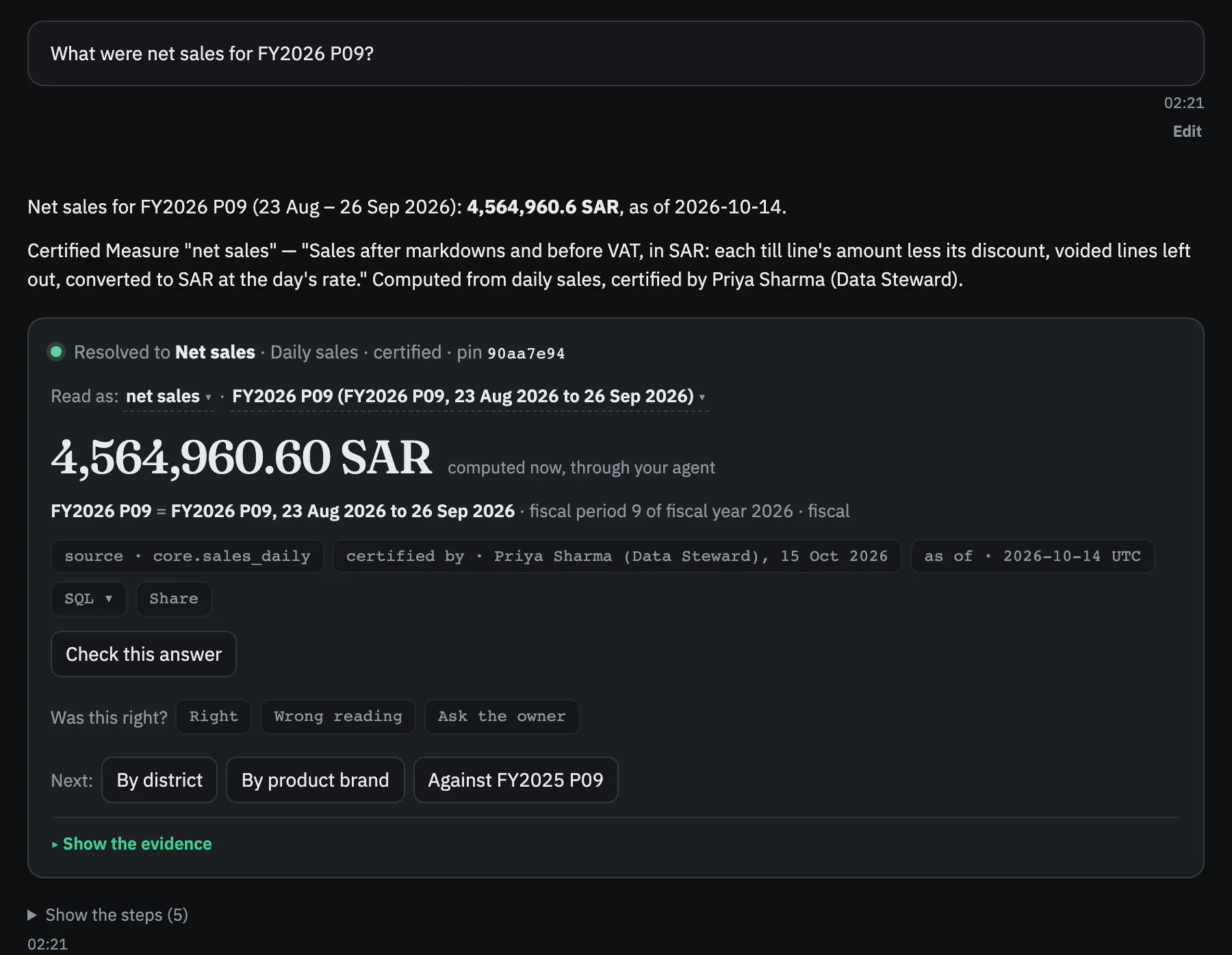
In Terazu, every number comes with a receipt. When someone asks for net sales in fiscal period 9, the question is read, the reading is checked against what’s certified, and it resolves to the certified Measure behind it. The figure is computed inside your database, through an agent on your network, and it comes back with what it rests on: how the question was read, the definition, who certified it and when, its pin, the source table, and the SQL that produced it.
The language model doesn’t compute any of that. It can read the question and narrate the answer, but the number comes from the governed engine, never from the model’s best guess. The governed answer doesn’t need a model at all.
When no certified Measure covers it
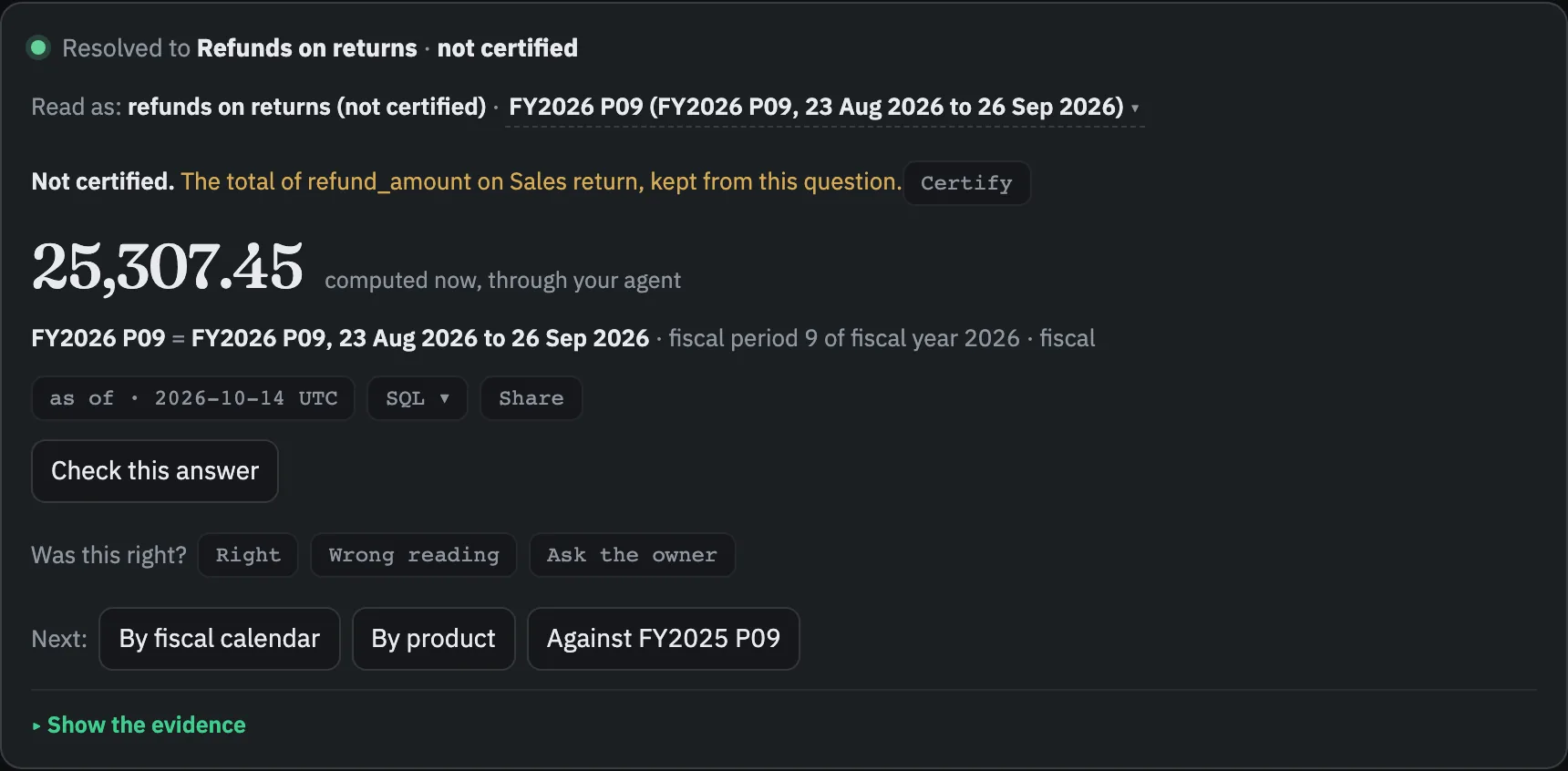
Most questions a data team gets aren’t covered by a certified Measure on day one. Terazu doesn’t stop there. When the certified pieces are enough to work the number out, it does, through the same governed path, and says plainly that the number isn’t certified and where it comes from. Certifying it is one click away, and Home lists the numbers people asked for that nothing certifies yet, the most asked first.
And when it can’t pin it down
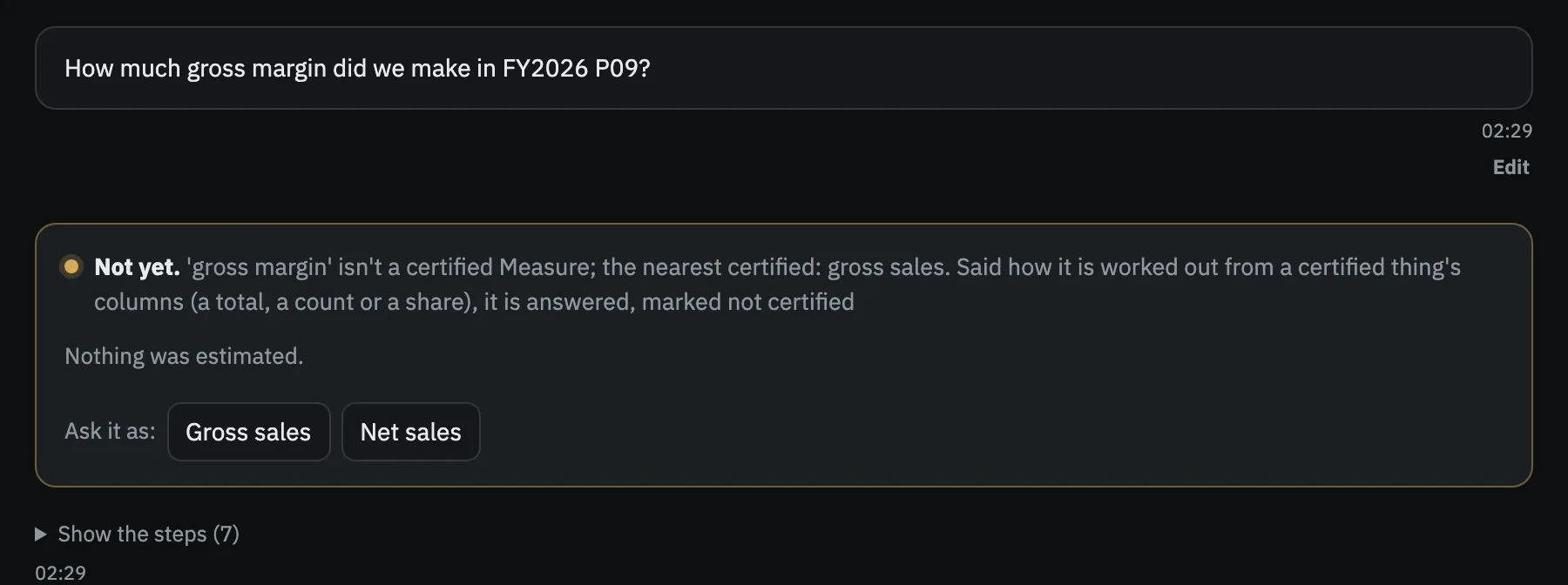
Some questions can’t be pinned down: nothing certified defines what they ask, or the words could mean two different numbers. There, Terazu refuses, and the refusal is specific. It names what’s missing, offers the certified Measures the question could be asked as, and says who can write the definition.
A system that only reports its wins is a system you can’t trust with a board number.
What that looks like in practice
On our demo estate, a simulated retailer with 24 stores, people asked for numbers no certified Measure answered. Two of them show both outcomes. Refunds on returns in fiscal period 9 came back as 25,307.45, marked not certified: the certified Sales return Object holds the refund amounts, so Terazu totalled them and kept the definition it used, for a person to certify. Gross margin was refused: no certified Measure defines it, and Terazu won’t invent a formula. The refunds now wait on Home among the numbers asked for and not certified. Gross margin waits for someone to define it.
Why refusing builds trust
A system that always answers can’t tell you when it’s guessing, so every answer inherits the doubt of its worst one. A system that says what each answer stands on gives you something to check: a certified number names who signed its definition, a number that isn’t certified says so and says where it came from, and a number it can’t pin down, it doesn’t give.
That changes how people work with it. An analyst doesn’t have to re-derive a number to trust it. Owners can see which definitions carry weight, because those are the ones questions keep landing on, and which numbers people keep asking for that nobody has certified. And an AI assistant connected over MCP inherits the same discipline: the same reading, or the same refusal with its reason, and a link to the receipt. The figure opens for the person who opens the link, never the model.
The discipline, in three rules
- Every number says what it stands on. A certified Measure, named, or a draft marked not certified, with where it comes from.
- Computed at the source. The number runs through your agent, in your network, with its SQL attached.
- Refuses what it can’t pin down. The refusal names what’s missing and who can fix it.
The refusal isn’t the product failing. It’s the product working.