A chase on the current demo, 2:25. Not the August chase in the text: this one asks which rules decide whether a store is comparable, and ends in a person’s ruling that later answers use. Recorded on 18 October on Meridian Simulation, a simulated retailer, before the changes noted above. Nothing is mocked up. Recorded under the working name, Ontos. Captions are in the player.
What to look at
When nothing certified covers a question and the certified pieces can’t work the number out, Terazu says so and names what’s missing. Often that’s where it should stop. But when someone wants the question answered, the next step is a chase: a read-only pursuit of a governed path from the question to an answer, through the evidence Terazu has already gathered.
This is what happens during one, using a real chase from our earlier demo estate, a synthetic retailer, in August 2026.
1. The question, and the invitation
Someone asked: how many units were returned? Nothing certified covered returns, so the answer was a refusal that named the missing definition. On Coverage, an unanswered question like this one offers its fix first, and Ask, under the row’s other actions, opens a new chat with the question typed in. Nothing runs until you send it.
A button, not a trigger. The assistant uses the chase tools only in a chat a person started, and a check it proposes waits as a card until that person approves it.
2. Probes: small reads, each one on the record
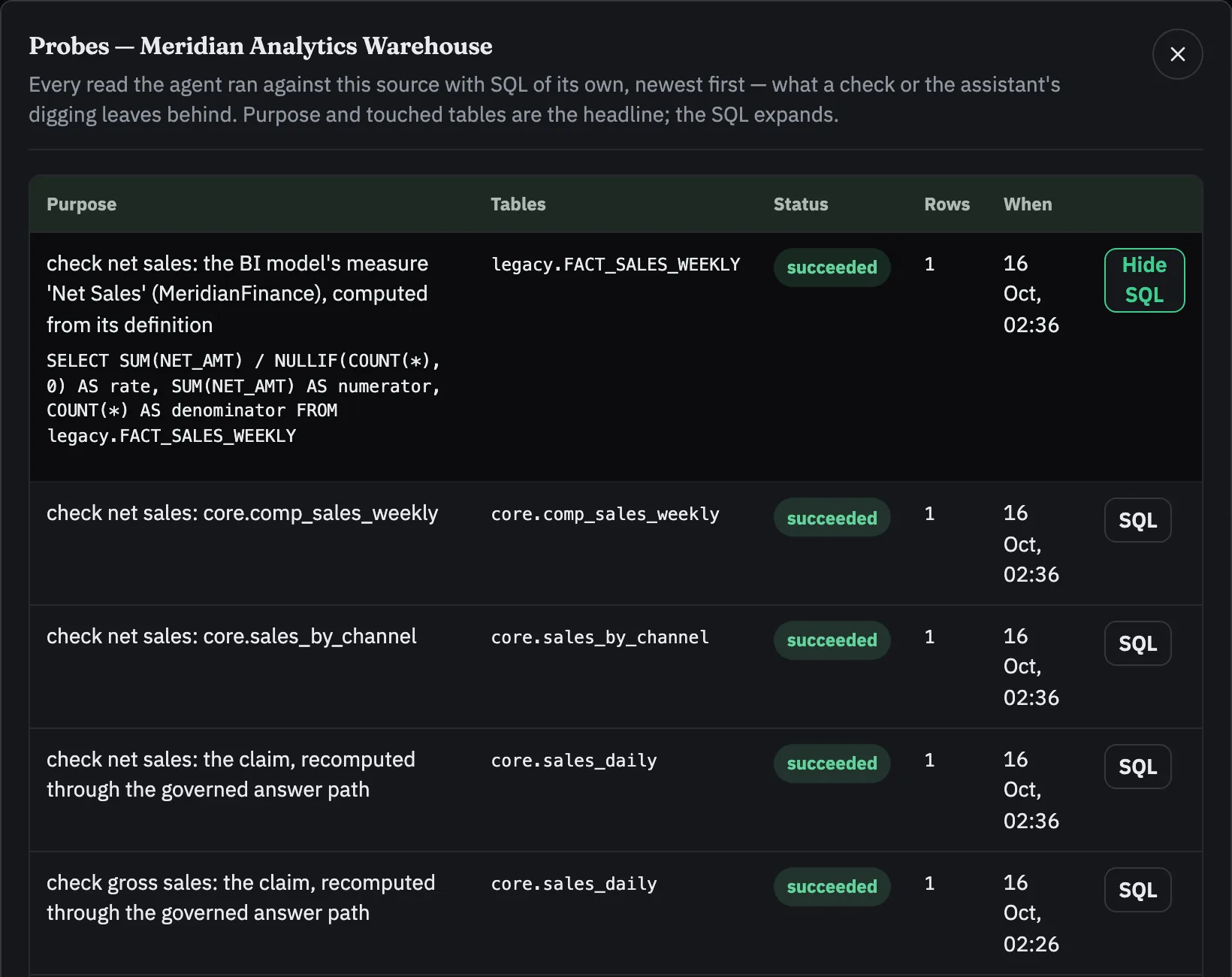
The assistant then works the way a good analyst works at a SQL prompt: look at what’s there, run a small query, let the result decide the next one. It starts from everything already ingested, such as schemas, keys, BI models, profiles and, where it’s on, query history, and when it needs to see the data itself it runs a probe.
A probe is deliberately narrow:
- One read-only SELECT, with a one-sentence purpose saying what it’s trying to learn.
- Checked twice. The control plane validates it as a single SELECT and rewrites it with a row limit in your database’s dialect; the agent in your network checks it again before running it.
- Capped at 200 rows, whatever was asked for.
- Recorded, whether it succeeds, fails or is refused: who ran it and why, the SQL that actually ran, the tables it touched, how many rows came back, and how long it took.
A chase also has an allowance: eight probes per turn by default. It keeps a record: its reads, the allowance used, each place it found tied to the read that showed it, and one next step. The figures in the record are filled in from the probes’ own results; the model never types a number a probe returned. On the demo, questions like this one took two or three probes.
3. What it found
The first probes found returns in two places. The warehouse table core.sales_return held 89,662.905 units over 180 rows. A legacy table, legacy.FACT_RETURNS, held 51,560.918 units over 120 rows. Two tables claiming to mean the same thing, 38,101.987 units apart.
A probe is a record of reading. It isn’t a claim about your estate.
That distinction matters. Probe results stay in their ledger, and they never feed ranking or answers. To turn a finding into something durable, a chase runs a verification.
4. Verify: a finding becomes a verdict
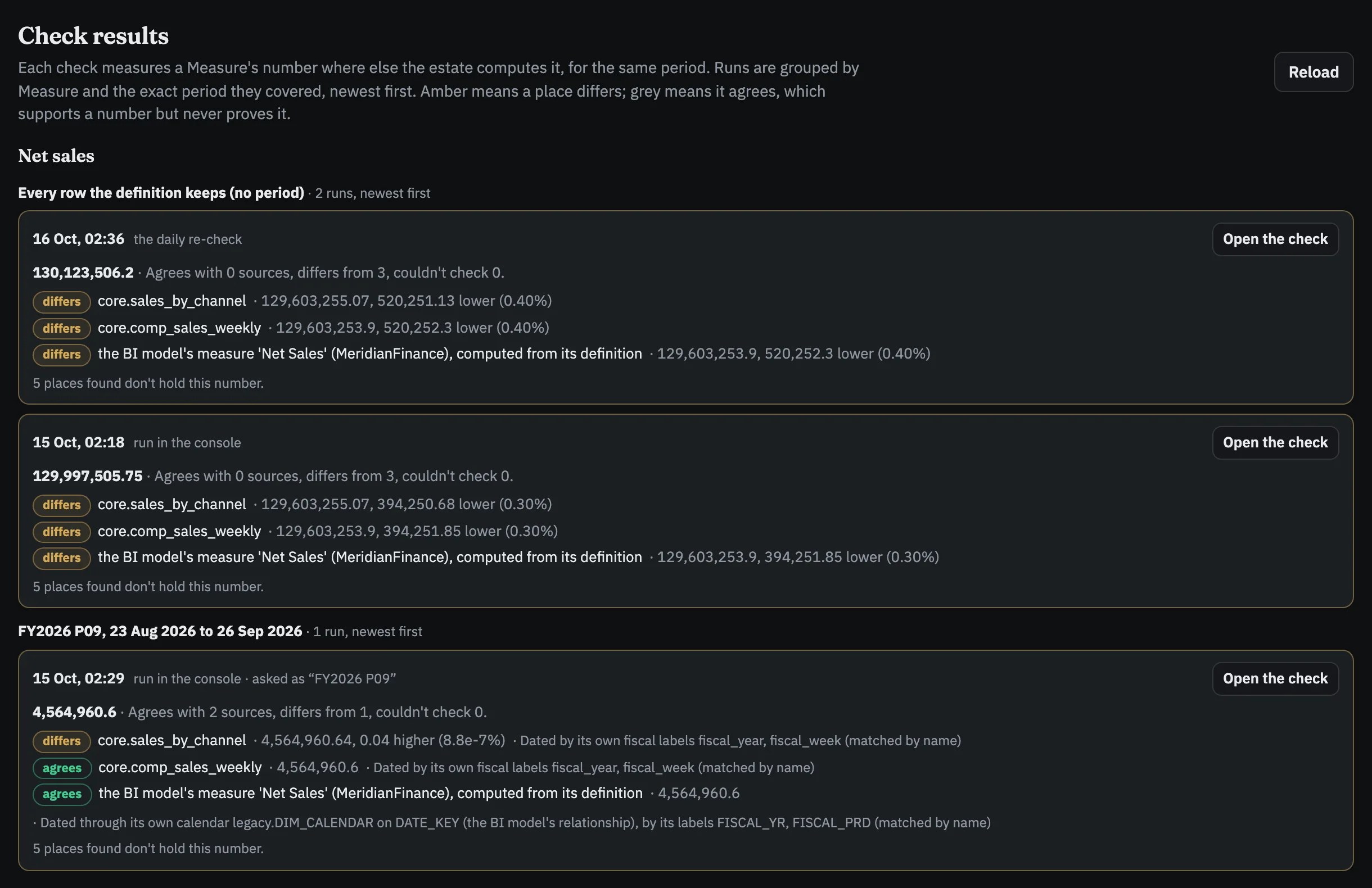
A verification is a fixed, versioned set of measurements for one kind of question: does this join hold (orphans, key containment, null keys), is this table’s key really unique, and do these two tables that claim one meaning agree.
Run on this pair, the divergence verification measured both tables and recorded one verdict, filed as evidence on both of them: the numbers, the version of the verification, and the probes it used. It reported the disagreement and picked no side. A comparison like this can show that two tables differ; it can never prove they’re equal. Deciding which one is right is a person’s job.
When the two tables live in different systems, each side is measured by the agent next to it, and only the totals are compared. The numbers travel; the rows don’t. In the chat, a person whose role may read live data can have the assistant probe, verify and check. A verification or a check, like a draft, waits as a card until a person approves it.
5. The two endings
A chase is meant to end one of two ways: a path a person can certify, or a refusal that names the input it’s missing. This one found a path: the assistant drafted an Object on core.sales_return and a Measure that sums its units, with the evidence behind it.
6. Certify, then serve
Today, once the Object on core.sales_return is certified, the kept draft answers straight away: the governed engine computes it and the answer says it isn’t certified, with Certify on its receipt. In August, a person reviewed the drafts and their evidence and certified them. Asked again, the question resolved to the certified Measure and returned 89,662.905, the same number the warehouse gives for the sum of units in that table, with its receipt.
The next person who asks gets that answer straight away, with no chase. Chase once, serve forever, until a governed change takes the definition back to review.
When the answer is a ruling
Some chases end in neither way. They find rules that disagree, and the data can’t say which one is right. The film above is one, on the current demo. Before certifying like-for-like sales, Priya Sharma, a data steward, asked for every rule in the estate that decides whether a store is comparable. The assistant found five places that decide. The two that matter, a rolling 370-day test and a legacy view frozen at the end of 2023, part on 151 store-weeks, about six million riyals of sales.
So Priya ruled: the 370-day test is right, a closed store keeps the weeks it traded, and the legacy view is out of date. The assistant turned the ruling into two cards to remember. Only the workspace’s owners and admins can save company knowledge, so Priya suggested both, and an owner saved them on Home and approved them in Checks › Memory. Each still says Priya suggested it. From then on, answers use them. Asked which rule decides, the assistant recalled the approved ruling and measured it against the data, and Claude Code, connected to Terazu over MCP, got the same rule, credited to Priya, with the caveat that it isn’t a certified Measure.
That is how the film was recorded. Since then, a ruling changes the contract itself. A ruling the chat writes carries the definition changes that make it true, and one card, Approve and certify, applies and certifies them as the person who approves. The model never certifies, and answers that use the ruling cite it.
And since then, AI tools outside Terazu, such as Claude Code, see shape, not content. Asked a question, one gets how the question was read, any refusal with its reason, and a link to the receipt. The figure opens for the person who opens the link, never for the model.
What a chase leaves behind
- Residue: every probe, in a ledger you can read. It answers “what was done?”.
- A record: the reads, the allowance used, each place found tied to the read that showed it, its figures filled in from the probes’ own results, and one next step.
- A verdict: evidence on both tables, with its numbers. It answers “what is now known?”.
- A draft definition that, once a person certifies it, serves every later ask.
- A ruling, when a person settles what the data can’t: it carries the definition changes that make it true, a person approves and certifies them on one card, and later answers cite it.
What a chase never does
It never writes to your data, never certifies anything, never produces the number an answer gives (the governed engine does), and never runs without a person asking and approving the check. The chase is how Terazu does the digging a data team would do. The certifying stays with the data team.
When a question already answers
A chase starts from a question with no answer. When a question does answer, Check this answer takes over. It states the number and its certified definition, measures it for the same period where else your estate computes it (the BI model’s measure, a report, another table), and says where each one agrees, where it differs and why, or what it couldn’t check. Agreement corroborates a number; it never proves it. When a person says which number is right, Terazu drafts the correction, and a person applies and certifies it. When two numbers disagree walks through one.