There are two ways to build the context an AI needs to answer business questions. You can model the whole company up front, which takes a year and is out of date on delivery. Or you can let the questions people actually ask pull the context into existence, one governed path at a time. Terazu does the second, and we call the result earned context.
It has five steps: ingest, chase, certify, serve and decay.
Ingest greedily
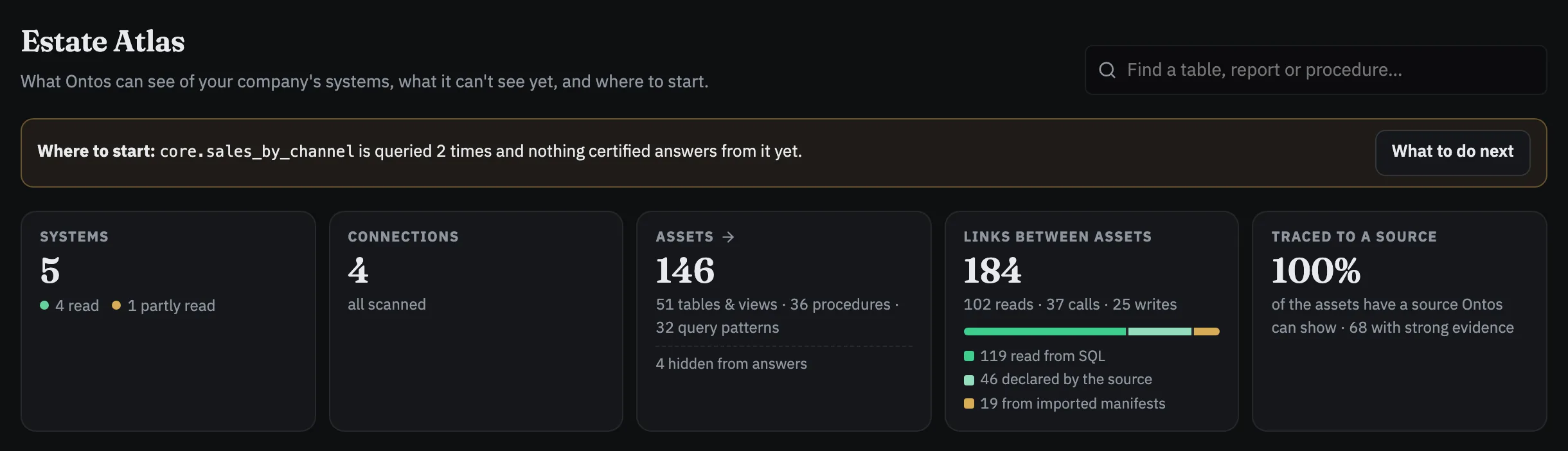
First, take in everything the estate already has: schemas and keys, the SQL in views and procedures, BI models and exported packages, report definitions, profiles of the data itself, and query history where a person turns it on. Ingesting is cheap, because it works on metadata and statistics, and it’s what lets Terazu say honestly what it can’t see. Anything it hasn’t reached is named as dark territory rather than quietly left out.
“We ingest everything” is the sentence every catalog vendor says. What matters is what happens next.
Chase lazily
When the certified pieces can’t work a question out, a person can start a chase: a read-only pursuit of a governed path from the question to an answer. It works through the evidence already gathered, runs bounded read-only probes through the agent in your network, and lets each finding decide the next probe. Inside a chase follows a real one, step by step.
A chase is meant to end one of two ways. Either it finds a path a person can certify (this Measure, on this table, at this grain, joined this way), or it refuses and names the missing input. Every probe is recorded in a ledger, and every verification leaves its verdict on the tables it measured: attributable evidence, not a paragraph lost in a chat window.
And when the data can’t settle a question, a person rules. The ruling carries the definition changes that make it true. One card, Approve and certify, applies and certifies them as the person who approves; the model never certifies. Later answers that use it cite the ruling. Inside a chase has a film of a chase that ends in a ruling.
Chasing is the expensive part, so it happens after the fact, and only for questions people actually ask. The questions everyone asks get certified directly; the chase is for the long tail and the unknown.
Certify
What a chase drafts on a certified meaning can answer at once, but it says it isn’t certified until a person signs it, and certifying it is one click from its receipt. Evidence ranks the options; it never decides between them. Certification pins the exact definition.
Serve
Once certified, the question is served the same way every time. The next person who asks gets the answer straight from the certified definition, with its receipt, and no chase at all. And a person can press Check this answer on the receipt: Terazu measures the number where else the estate computes it and says where they agree or part. Agreement corroborates; it never proves.
Chase once, serve forever.
Decay
Forever, on one condition. A certified definition serves until a governed event takes it back: a breaking change underneath it, a renamed column, a dropped table. Then it drops back to review before anyone sees a new number. What it never does is rot silently, still answering from something that has changed.
Why the order matters
The failure of AI on enterprise data isn’t a lack of context. It’s context nobody vouches for: a model finds a table that looks right and answers from it. Earned context labels every answer with what it stands on, puts a person between every finding and the certified contract, and spends effort where the questions are. The contract grows with use, starting from the questions that matter, instead of from a model of the whole enterprise that nobody asked for.